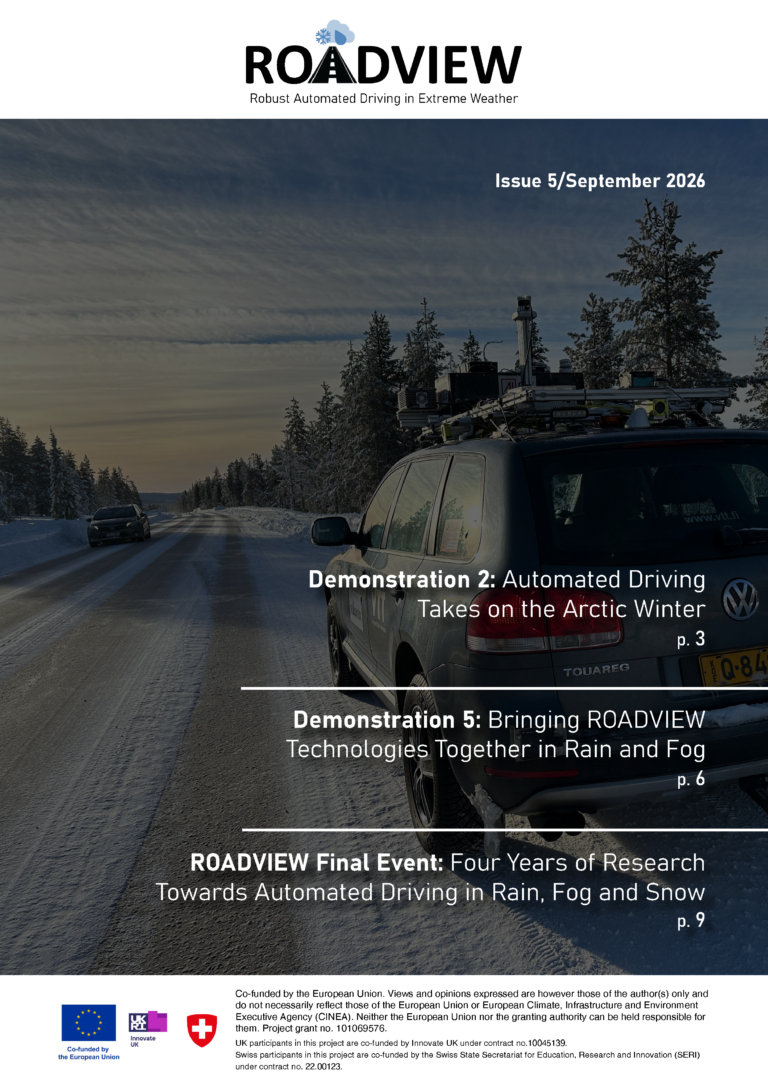
Welcome to the final edition of the ROADVIEW newsletter. After four years of research, development, integration and validation, the ROADVIEW project officially came to an end on 31 August 2026. In this concluding issue, we look back at some of the project’s final and most important achievements and at how ROADVIEW has advanced automated driving towards safer and more reliable operation in adverse weather conditions.
We begin with Demonstration 2, carried out in the demanding winter conditions of Finnish Lapland. Led by VTT, the demonstration brought together ROADVIEW technologies for visibility and slipperiness estimation, HD-map-based localisation, cooperative perception, V2X communication and weather-aware decision-making on an automated vehicle. Testing on closed tracks and public roads showed how these technologies can work together to support safe automated driving in snow, ice and reduced visibility.
Next, we turn to Demonstration 5, ROADVIEW’s final vehicle-level integration campaign at the AVL Mobility and Sensor Center in Roding, Germany. Using AVL’s AutBus platform and the controlled conditions of the AVL weather hall, project partners evaluated technologies for LiDAR outlier detection, visibility and grip estimation, HD-map localisation, weatherconditional navigation and velocity control, as well as infrastructure-based perception and V2X communication under rain and fog. The demonstration showed that several ROADVIEW technologies developed by different partners could be integrated and operated simultaneously within a common automated driving platform.
Finally, we report on the ROADVIEW final event, held on 19 August 2026 at the AVL Mobility and Sensor Center. The event marked the culmination of four years of collaborative research by 15 partners from industry and academia across seven European countries. It showcased the project’s advances in perception, localisation, connected intelligence, weather-aware decision-making and validation, as well as the datasets and research results that will remain available to support further development beyond the project.
As ROADVIEW comes to a close, we would like to thank all project partners, researchers, stakeholders and members of the wider automated mobility community who have contributed to and followed the project throughout its journey. The project may have officially ended, but its results provide a foundation for continued research and development towards automated vehicles that can operate more safely and reliably not only in fair weather, but also in rain, fog, snow and other challenging environmental conditions.
We hope you enjoy this final edition and the read!